Address
304 North Cardinal St.
Dorchester Center, MA 02124
Work Hours
Monday to Friday: 7AM - 7PM
Weekend: 10AM - 5PM
Address
304 North Cardinal St.
Dorchester Center, MA 02124
Work Hours
Monday to Friday: 7AM - 7PM
Weekend: 10AM - 5PM

Water treatment agent (Water treatment agent) is a general term for a class of chemical agents used for water treatment, and is often easily understood as a chemical agent for sewage treatment. It actually includes chemicals required for sewage treatment, treatment of cooling water and boiler water, desalination, membrane separation, biological treatment, flocculation and ion exchange technologies. Such as corrosion inhibitor, scale inhibitor and dispersant, bactericide and algicide, flocculant & coagulant, ion exchange resin, purifier, cleaning agent, pre-film agent, auxiliary chemical agent, etc.
Its applications include industrial water, municipal/drinking water treatment, sewage wastewater treatment, and seawater desalination.
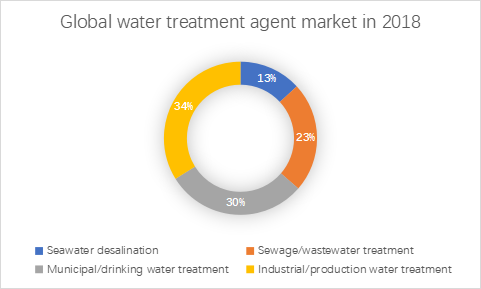
From the perspective of application fields, industrial/production water treatment, municipal/drinking water treatment, sewage/wastewater treatment and seawater desalination water treatment agents are the main downstream fields, and the market size in 2018 was 11.675 billion US dollars, 10.250 billion US dollars, 8.05 billion US dollars and 4.530 billion US dollars, respectively. The market share was 33.88%, 29.74%, 23.23% and 13.15%, respectively.
In the field of industrial water, it is mainly used in industrial circulating water treatment and industrial boiler water treatment. Industrial circulating cooling water treatment agent is the key to industrial water saving, which refers to the necessary chemical agent in the treatment process of industrial water cooling tower, cold water machine and other equipment. Through the use of these chemicals, the water quality can meet certain quality requirements, ensure that the cooling water tower, water cooler and other equipment are in the best operating state, effectively control the microbial flora, inhibit the generation of scale, prevent corrosion of pipeline equipment, to reduce energy consumption, extend the service life of the equipment. The chemical agents used in industrial circulating water treatment mainly include scale inhibitor, corrosion inhibitor, bactericidal and algicidal agent, cleaning agent and pre-film agent. The common methods of industrial boiler water treatment are external water treatment and internal water treatment, and the chemical agents used are mainly: corrosion and scale inhibitor, oxygen removal agent, feedwater alkali reduction agent, ion exchange agent, regenerant, softener, alkalicity regulator, scale cleaning agent, etc.
Municipal/drinking water treatment, where collected water needs to be treated to ensure safe drinking water standards are met. The water treatment process usually includes steps such as purification, disinfection, removal of suspended solids and impurities to ensure clean water quality. The water treatment chemicals involved are generally: bactericidal algaecide, flocculant, corrosion inhibitor and so on.
Sewage treatment, sewage treatment chemicals are a class of industrial wastewater, domestic sewage treatment for standard discharge or recycling of the process of the use of chemical agents. Sewage discharge has led to serious pollution of water resources and living environment, in order to prevent the deterioration of this phenomenon, the water treatment industry has developed a number of large-scale water treatment equipment, so that it can be applied in people’s production and living sewage treatment. Many enterprises discharge sewage containing a large number of difficult to degrade substances, through a single water treatment equipment can not be effectively removed, so many times to add sewage treatment chemicals according to the particularity of sewage water quality, so that the treated sewage in line with the national discharge standards. The water treatment agents involved generally include flocculant, coagulant, coagulant aid, disinfectant, pH regulator, defoamer, demulsifier, oxidation-reducing agent, etc.
The main technologies of seawater desalination include distillation and membrane process. The membrane is easily blocked in use, so it is necessary to add scale inhibitor, detergent, flocculant, scale inhibitor and dispersant to the water. The distillation method is easy to produce scale and thus reduce the evaporation efficiency. Polyphosphate, organic phosphoric acid and phosphate-based polycarboxylic acid can be added to the raw water to soften the water quality, and calcium, magnesium ions and other metal ions can be chelated to make it not easy to precipitate and prevent the formation of scale.
