Address
304 North Cardinal St.
Dorchester Center, MA 02124
Work Hours
Monday to Friday: 7AM - 7PM
Weekend: 10AM - 5PM
Address
304 North Cardinal St.
Dorchester Center, MA 02124
Work Hours
Monday to Friday: 7AM - 7PM
Weekend: 10AM - 5PM

Part 2: The Silent Killer — Mechanisms of Water Blocking and Capillary Resistance
2.1 Capillary Pressure: The Absolute Ruler in Nanopores
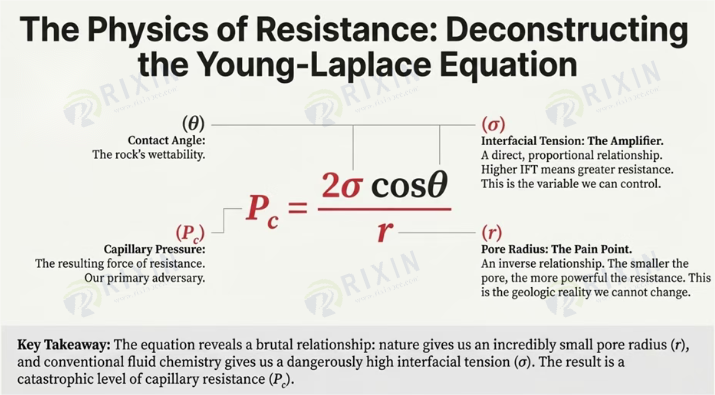

In tight sandstone and shale matrices, pore throat radii are extremely small, typically ranging from nanometers to microns. This extreme spatial confinement makesCapillary Pressure (Pc)the primary resistance to fluid flow. According to the classicYoung-Laplace Equation:
This equation reveals a brutal relationship among three core variables:
1. Interfacial Tension (σ): Proportional relationship. Higher IFT means greater resistance.
2. Contact Angle (θ): Reflects the hydrophilicity/lipophilicity of the rock surface.
3. Pore Radius (r): Inverse relationship. This is the pain point of unconventional development—when r decreases by a factor of 1000 (from conventional microns to shale nanometers), the resistance Pc increases directly by a factor of 1000.
Under the action of conventional fracturing fluid (High IFT), the capillary resistance generated by nanopores can reach several Megapascals (MPa). This implies that unless the formation can provide an extremely high driving pressure differential, the invaded fracturing fluid cannot be expelled, and hydrocarbons cannot enter the fractures.
2.2 Water Blocking and Jamin Effect: The Terminators of Flow
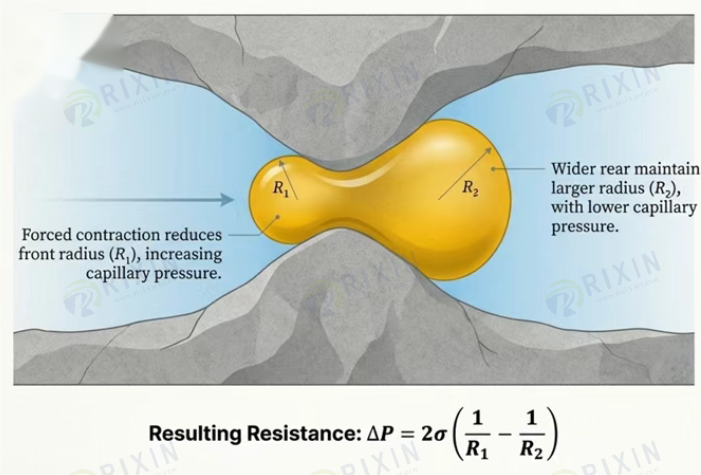
Water Blocking, also known as Liquid Blocking, refers to the phenomenon where, due to capillary confinement, foreign fluids (fracturing fluid filtrate) are trapped in the pores of the near-wellbore zone or fracture faces, causing the reservoir’s Relative Permeability to approach zero.
One of its microscopic manifestations is the Jamin Effect. When a non-wetting phase droplet (e.g., an oil droplet) attempts to pass through a constricted pore throat filled with a wetting phase (water), the droplet must deform.
1. The front of the droplet is forced to contract, reducing the radius of curvatureR1and increasing capillary pressure.
2. The rear of the droplet remains wider, with a larger radius of curvature R2 and lower capillary pressure.
The resulting additional resistance ΔP = 2σ (1/R1– 1/R2) acts like a stubborn plug, preventing droplet movement. If the interfacial tensionσis high, the droplet surface behaves like a taut rubber skin—rigid and resistant to deformation—ultimately causing the fluid to get “stuck” at the throat.
2.3 Threshold Pressure Gradient: The Limits of Formation Energy
To overcome the aforementioned resistance, an external pressure must be applied, known as the Threshold Pressure or Kick-off Pressure.

In low-pressure hydrocarbon reservoirs, formation energy is often very limited. If the fracturing fluid’s IFT remains at conventional levels (20-30 mN/m), the calculated threshold pressure often far exceeds the formation’s own energy level. The result is catastrophic: fracturing fluid cannot flow back, forming a permanent damage zone, and well production falls far below expectations. This is not just a technical failure but a massive economic loss.
2.4 Data Testimony: The Cost of High Interfacial Tension
Laboratory core flooding experiments and field data both confirm the strong correlation between interfacial tension and reservoir damage:
• High IFT Systems: Cause 70-90% reduction in near-wellbore permeability, with flowback rates as low as 10-20%.
• Low IFT Systems: Permeability recovery can improve to around 70%.
• Ultra-Low IFT Systems (10-3mN/m): Permeability recovery can reach over 90%. Moreover, throughSpontaneous Imbibition, the fracturing fluid can actively displace hydrocarbons from the matrix, turning a “hazard into a benefit”.
Since reducing interfacial tension is the sole physical pathway to solving water blocking and unlocking productivity, accurately measuring this key parameter becomes the paramount issue. Traditional measurement methods fail one after another when ensuring the order of magnitude of “Ultra-Low.” In the next part, we will introduce the ultimate arbiter in this field—the Spinning Drop Tensiometer—and explain why it is the sole standard for measuring Ultra-Low IFT.
