Address
304 North Cardinal St.
Dorchester Center, MA 02124
Work Hours
Monday to Friday: 7AM - 7PM
Weekend: 10AM - 5PM
Address
304 North Cardinal St.
Dorchester Center, MA 02124
Work Hours
Monday to Friday: 7AM - 7PM
Weekend: 10AM - 5PM

In the last part, we established the profound dialectical relationship between interfacial tension and the demulsification effect of the demulsifier: it is both the necessary driving force to break the oil-water interface and a key variable that needs to be precisely controlled at the “optimal hitting point” to avoid the formation of microemulsions. Since interfacial tension plays such a central role in the mechanism of demulsification, accurately obtaining this value has become an important way to verify the effectiveness of a formulation. Any theory that cannot be quantified is pale in industrial application. For engineers, if they cannot accurately capture the microscopic mechanical behavior of surfactant molecules at the interface, all screening and compounding work will devolve into blind trial and error. Therefore, before mastering the secret of high-performance demulsifiers, we must first discuss how to use scientific methods to test interfacial tension, especially when faced with those extremely challenging ultra-low values, and how we should find the “eyes” that can see the truth.

3.1 Limitations of Traditional Measurement: When Gravity Fails
In routine interface chemistry laboratories, methods for measuring surface and interfacial tension are varied, such as the Wilhelmy Plate, Du Noüy Ring, and Pendant Drop Method. These methods excel when measuring common liquids (like water or conventional oils, with tension between 20-72 mN/m). However, when we enter the realm of Ultra-Low Interfacial Tension (< 10-2mN/m), these traditional methods, based on gravitational equilibrium, encounter a physical “Achilles’ heel”. That is, under ultra-low tension conditions, the droplet’s own gravity is more than a million times greater than the interfacial tension to be measured.
The Pendant Drop Method calculates tension by analyzing the shape of a droplet hanging from a needle tip using the Young-Laplace equation. The droplet’s shape depends on the balance of two forces: Gravity tries to elongate or detach the droplet, while Interfacial Tension tries to shrink the droplet and keep it spherical. This balance is described by the dimensionless Bond Number (Bo):
Where Δρ is the density difference, g is gravitational acceleration, R is the droplet radius, and γ is interfacial tension.
When γ becomes very small (ultra-low tension), the Bond Number Bo becomes very large. This means gravity’s influence far outweighs tension. The result is:
1.Droplet Detachment
Interfacial tension is insufficient to support the droplet’s weight, causing it to drip rapidly from the needle, failing to form a stable pendant shape for camera capture.
2.Shape Error
Even if the droplet barely hangs on, if the density difference is small, the droplet remains nearly perfectly spherical. For spherical droplets, the Bond number approaches zero, and shape analysis algorithms cannot fit tension through curvature changes, causing calculation errors to amplify exponentially.
As numerous studies note, for measurements below 10-2mN/m, the pendant drop method is not only extremely difficult to operate but often yields unreliable data.
3.2 Triumph of Centrifugal Force: The Uniqueness of the Spinning Drop Method
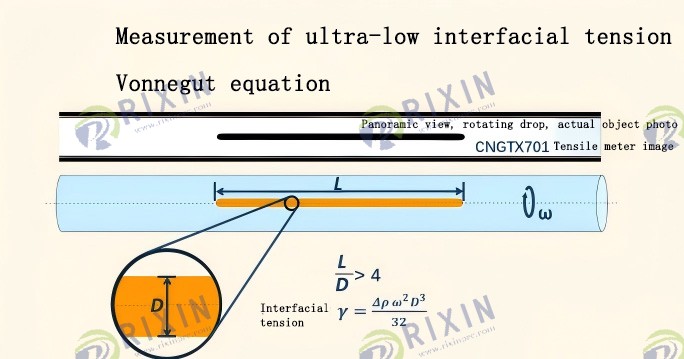
To measure these forces so weak they are almost non-existent, scientists must introduce a force more powerful and controllable than gravity—Centrifugal Force. This is the moment the Spinning Drop Tensiometer takes the stage.
Principle:
The core principle of the spinning drop method involves injecting a low-density droplet (like oil) into a horizontal fine glass capillary filled with a high-density matrix liquid (like water/surfactant solution). When the capillary rotates at high speed around its axis, a massive centrifugal force field (up to thousands of times gravity) pushes the heavy phase liquid outward toward the tube wall, while the light phase oil droplet is pushed toward the axis of rotation.
Under the squeeze of centrifugal force, the oil droplet is elongated into a slender cylinder. At this point, two opposing forces exist:
Centrifugal force:
Attempts to elongate the droplet, increasing its surface area.
Interfacial tension:
Attempts to shrink the droplet, restoring it to a sphere (minimum surface area).
When these two forces reach equilibrium, the droplet forms a stable cylindrical shape. According to the Vonnegut Equation, we can calculate the interfacial tension with extreme precision by measuring the droplet’s diameter (d) and rotational speed (ω):

The spinning drop method is currently the sole method capable of accurately measuring ultra-low interfacial tensions in the range of 10-2mN/m to 10-6mN/m. Its advantages are that it does not require contact angle measurement, is unaffected by wettability, and can cover an extremely wide measurement range by adjusting rotational speed.
3.3 Crystallization of Cutting-Edge Tech: The CNGTX Spinning Drop Tensiometer
The launch of the CNGTX 600/700 series spinning drop tensiometer represents a paradigm shift in spinning drop tensiometry, transforming the instrument from a manual observation tool into an active, intelligent control system. By addressing the fundamental physical limitations of the previous generation TX500C model—specifically “field-of-view paradoxes” and “axial drift”—CNGTX has established a new standard for measuring ultra-low interfacial tension (10-3mN/m and below).
CNGTX Spinning Drop Tensiometer Evolutionary Path: From Feasibility to Industry Benchmark
The development of the spinning drop tensiometer has progressed through three critical stages, moving from laboratory prototypes to digital standards, and finally to intelligent leadership:
Model 500 Era (Pre-2000): Produced by the University of Texas, this stage addressed the feasibility of measuring ultra-low IFT, relying on manual visual observation and the Vonnegut Equation.
TX500C Era (2000-2019): Launched in 2000 by Bowing Industry Corporation, the TX500C introduced CCD technology, improving precision to microns and enabling digital storage. It became the flagship choice for China’s energy sectors.
CNGTX 600/700 Series Period (2019 to Present): CNG ENTERPRISES LIMITED introduced the CNGTX brand’s 600/700 series, which used artificial intelligence technology to solve the inherent problems of the TX500C. Compared to the previous generation TX500C product, the new series completely solved the long-standing industry problems of “restricted field of view” and “droplet drift” by utilizing CNGTX’s unique “dual-optical imaging system with full capillary visibility” and “Spinning drop position detection and control” patented technologies. By achieving a transformation from a “restricted field of view” to seeing the “full picture” of the rotating droplet, and from “droplet drift” to making the rotating droplet “still,” the CNGTX 600/700 Series spinning drop tensiometers completed a generational leap in ultra-low interfacial tension measurement, transitioning from manual to intelligent measurement.
Seeing the Complete Picture: Why a Full View of the Measuring Tube is Critical for Accurate Ultra-Low IFT Measurement?
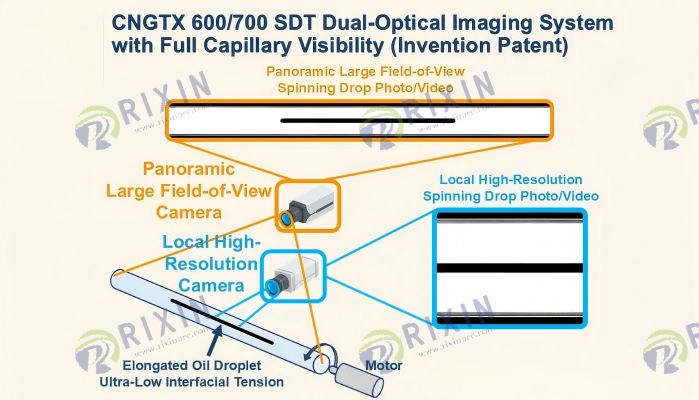
In ultra-low IFT measurement, data accuracy challenges stem from a fundamental paradox of physics: magnification is inversely proportional to the field of view (FOV).
1.Geometric Prerequisite of Vonnegut Equation
The Vonnegut Equation requires L/D ≥ 4. Under ultra-low tension, seeing micron details shrinks the FOV to millimeters. Traditional single-lens systems cannot verify the overall geometry.
2.Revolutionary Dual-Optical Imaging System Design
CNGTX breaks this deadlock with its patented “Dual Vision“: a Panoramic Path for global monitoring and a Measurement Path for sub-micron precision. This decouples “searching” and “measuring,” ensuring absolute data integrity.
Keep the Spinning Drop Still: Why “Automatic Locking and Position Control” Is the Key to Precise Ultra-Low IFT Measurement?
In reality, gravitational tilt (even 0.01°), thermal Marangoni convection, and mechanical vibrations cause the drop to “drift” axially. Under ultra-low tension, drops are hypersensitive; any rough manual magnification adjustment can cause rupture or data gaps.
Deconstructing the Core Patent
The CNGTX 600/700 series installs an “autopilot” via its patented technology:
AI Detection (The Eye) for pixel-level tracking in cloudy phases;
Intelligent Algorithms (The Brain) for smooth, trend-based intelligent correction;
Precision Mechanism (The Muscle) utilizing a self-locking Worm Gear structure (similar to 5-axis CNC tables) for micro-radian “rigid” locking.
2.Core Benefits for Ultra-Low IFT
Pixel-level Repeatability: Eliminates operator individual differences; the droplet is always in the same optical center and lighting conditions, regardless of who operates it.Supports “long-term” testing: Meets the needs for longer adsorption equilibrium, completely eliminating the trouble of experimental failure caused by the droplet moving out of the field of view at night.
Technical Comparison Summary
| Characteristic | Model 500 | TX500C | CNGTX600/700 |
| Measurement method | Manual table lookup calculation | Manual mouse drawing | Intelligent fully automatic measurement |
| Observation method | Visual microscope | CCD + Single Lens Zoom | Panoramic + Local Dual-Light Path |
| Position control | Manual adjustment | Manual + Electric Image Finder | AI locking + automatic control |
| mechanical precision | Low | middle | High micro-arc level self-locking mechanism |
| Experimental success rate | Dependency techniques | Limited by the operator | Extremely high (unattended) |
With the “Eye of Science”—the CNGTX Spinning Drop Tensiometer SDT—now fully open, we can finally precisely capture those Ultra-Low Interfacial Tension (Ultra-Low IFT) signals that were once invisible to traditional measurement methods. Testing ultra-low interfacial tension is also commonly used in EOR for the screening and formulation optimization of surfactants. However, seeing the battlefield clearly is only the first step toward victory. Faced with thousands of chemical reagent candidates, data itself does not automatically translate into a solution. The real challenge lies in: How do we use this data, precise to 10-3mN/m, to formulate a winning tactic? How do we translate every rotation within a laboratory capillary into the efficient separation of millions of tons of oilfield-produced fluid on site? In this final chapter, we leave the observation deck and enter the “Command Center” of formulation design, revealing how engineers utilize this scientific ruler—from massive screening to precise compounding—to forge the “Champion Demulsifier” capable of delivering a decisive blow.
