Address
304 North Cardinal St.
Dorchester Center, MA 02124
Work Hours
Monday to Friday: 7AM - 7PM
Weekend: 10AM - 5PM
Address
304 North Cardinal St.
Dorchester Center, MA 02124
Work Hours
Monday to Friday: 7AM - 7PM
Weekend: 10AM - 5PM

With the large-scale development of deep natural gas and unconventional oil and gas resources, issues such as casing damage, external casing channeling, and cement sheath failure in oil and gas wells can lead to a loss of wellbore integrity, negatively impacting production efficiency and safety. To address different leakage scenarios, researchers both domestically and internationally have developed various types of plugging agents, including:
(1) Inorganic materials, mainly composed of cement and additives, are used for sealing of casing leaks, cement sheath failures and severely leaking formations;
(2) Bridging materials are mainly composed of natural materials such as walnut shells, mica, and rice husks. They have the advantages of wide availability, easy operation, and good compatibility. They are mainly used for formation leakage and large channel sealing.
(3) High filtration loss materials are mainly made by compounding materials such as permeation materials, diatomaceous earth, and bridging agents. These materials are only suitable for small-scale seepage in formations.
(4) Chemical gel materials, mainly composed of polyacrylonitrile or polyacrylamide and copolymers of the two, have a certain sealing effect, but have the disadvantages of high cost and inconvenient construction;
(5) Differential pressure activated sealing material, composed of nitrile latex and activator, can be used to seal micro-leaks in casings and hydraulic control lines. It only gels at the leak location and has good safety and compressive strength. The above-mentioned sealing materials have certain problems in use, such as: inorganic materials, bridging materials and high filtration loss materials are solid-liquid suspension systems. Due to particle size limitations and low curing strength, they have problems such as low success rate of one-time repair, poor high temperature resistance and difficulty in adhering to the pipe wall when repairing casings; chemical cementing materials have problems such as short sealing period and poor pressure resistance; while differential pressure activated sealing material lacks the ability to seal larger leaks, and the system needs to match the size of the leak to achieve the sealing effect.
Based on the above problems, there is an urgent need to develop high-strength plugging agents to address the integrity issues of oil and gas wellbores, ensuring both the injection capacity of the plugging agent and the effectiveness of sealing leaks. Foreign researchers started developing high-strength plugging agents earlier, and their products provide high-strength sealing of the annulus (pressure resistance >50 MPa). However, they also have the problem of uncontrollable curing time; improper operation may cause the agent to solidify in the mixing tank and pipeline, resulting in equipment damage and construction safety issues. Currently, China lacks domestically developed high-strength plugging agent products with equivalent sealing capabilities.
Therefore, this paper optimizes the preparation materials of liquid high-strength plugging agent in order to obtain a plugging agent with both injection and sealing performance, characterizes the properties of the plugging agent, explores the curing mechanism of the plugging agent, tests the sedimentation and sealing performance of the plugging agent, explores the ability of the plugging agent to settle and seal in a simulated casing at a height of 20 m, and conducts field application tests of the plugging agent.
1. Experimental Section
1.1 Materials and Instruments
Bisphenol A type epoxy resin (E44, E51, E42), industrial grade, Shanghai Maclean Biochemical Technology Co., Ltd.; Polyphenylene ether ketone, effective content 98%, Anhui Zesheng Technology Co., Ltd.; Isopropanol, effective content 98%, Shanghai Maclean Biochemical Technology Co., Ltd.; Ethyl sulfate, effective content 99%, Anhui Zesheng Technology Co., Ltd.; γ-methacryloyloxypropyltrimethoxysilane (KH570), analytical grade, Fuchen (Tianjin) Chemical Reagent Co., Ltd.; Benzooxazine, 99%, Hubei Xinrunde Chemical Co., Ltd.
DV2TLV rotating Brinell viscometer, Bollefeld, USA; Perkin Elmer Frontier infrared spectrometer, Perkin Elmer, USA; S4800 scanning electron microscope, Hitachi, Japan; HY-20080 universal testing machine, Shanghai Hengyi Precision Instruments Co., Ltd.
1.2 Experimental Methods
(1) Preparation of high-strength liquid sealant
Epoxy resin (E44, E51, E42), polyphenylene ether ketone and isopropanol were added to a 100 mL beaker in a specific mass ratio and stirred at 200 r/min for 30 min using a magnetic stirrer to obtain the main agent.
Ethyl sulfate and KH570 were added to a 100 mL beaker at a specific mass ratio, heated to 60 °C and held for 10 min, and then stirred at 200 r/min for 10 min using a magnetic stirrer to obtain the curing agent.
The main agent and the curing agent are mixed in a specific mass ratio and stirred evenly to obtain the sealing agent system.
(2) Viscosity measurement
Referring to the national standard GB/T 10247—2008 “Viscosity Measurement Method”, the viscosity of the sealing agent system was tested using a rotating Brinell viscometer at a temperature of 25℃ and a rotation speed of 6r/min.
(3) Infrared spectroscopy characterization
After the liquid high-strength sealant system was mixed with potassium bromide and pressed into sheets, infrared spectroscopy was performed using a Perkin Elmer Frontier spectrometer [equipped with a deuterated triglycine sulfate (DTGS) detector and a transmission unit (Harrick)].
(4) Scanning electron microscopy characterization
After the sealant has cured, the sample is cut and broken, then pasted onto conductive adhesive. After drying, the morphology of the cut surface of the cured sample is observed using a scanning electron microscope.
(5) Mechanical property testing
The compressive strength of pre-prepared plugging agent columns (15.0 cm in length and 2.5 cm in diameter) was determined using a universal testing machine. Three plugging agent column specimens were used for five compressive strength tests, and the average value of the results was taken.
2 Results and Discussion
2.1 Preferred Liquid High-Strength Blocking Agent
2.1.1 Optimal Selection of Main Agent
Epoxy resin, polyphenylene ether ketone (PPE), and isopropanol were compounded in different mass ratios to prepare the main plugging agent. Epoxy resin, as the main structural component, can couple with the curing agent to form hydrogen bonds, constructing a network structure and creating a high-strength cured structure. PPE has a reinforcing and toughening effect, reducing the hardness after curing and increasing the flexural strength, allowing the plugging agent to adhere to the casing wall. Isopropanol, as a diluent, reduces the viscosity of the main agent, ensuring smooth injection. The main agent and curing agent (ethyl sulfate and KH570 in a mass ratio of 4:1) were mixed in a 4:1 mass ratio and stirred evenly. The curing test results of the resulting plugging agent are shown in Table 1. Epoxy resins with different epoxy equivalents were used in the experiment, and the results showed that there were significant differences in properties between epoxy resins with different epoxy equivalents. When the epoxy resin is E51, the initial setting time of the plugging agent is relatively short, and the curing is relatively fast. When the epoxy resin is E42, the initial setting time of the plugging agent varies with the amount of toughening agent added, ranging from 4 to 12 hours, and the curing time is 36 to 48 hours. When the epoxy resin is E44, the initial setting time is moderate, around 5 hours, and the curing time is 28 to 32 hours. This is because the higher the equivalent of the epoxy groups, the easier it is to form a network structure during the curing process, thereby rapidly increasing the viscosity and the curing speed. For safety considerations during plugging, a plugging agent with a longer initial setting time must be selected. In addition, due to the possible annular pressure in oil and gas wells, a plugging agent with a relatively short curing time must be selected to avoid gas upwelling during the curing process, which could lead to plugging failure. Therefore, formulation 9 (epoxy resin E44, polyphenylene ether ketone, and diluent isopropanol in a mass ratio of 20:7:5) was selected for subsequent experiments.
Table 1. Effect of the main agent on curing performance
| Main agent serial number | Types of epoxy resins | The mass ratio of epoxy resin, polyphenylene ether ketone, and diluent isopropanol | Initial setting time/h | Curing time / h |
| 1 | E51 | 20:3:5 | 2 | twenty two |
| 2 | 20:5:5 | 2 | 20 | |
| 3 | 20:7:5 | 3 | 19 | |
| 4 | E42 | 20:3:5 | 12 | 48 |
| 5 | 20:5:5 | 7 | 44 | |
| 6 | 20:7:5 | 4 | 36 | |
| 7 | E44 | 20:3:5 | 5 | 32 |
| 8 | 20:5:5 | 5 | 28 | |
| 9 | 20:7:5 | 5 | 28 |
2.1.2 Preferred Curing Agent
The main agent (epoxy resin E44, polyphenylene ether ketone, and diluent isopropanol in a mass ratio of 20:7:5) was mixed with curing agents formulated with ethyl sulfate and KH570 at different ratios to investigate the effect of the curing agent on the curing performance. The experimental results are shown in Table 2, with a main agent to curing agent mass ratio of 4:1. Table 2 shows that the smaller the mass ratio of ethyl sulfate to KH570, the longer the initial setting time and the longer the curing time. When the mass ratio of ethyl sulfate to KH570 is below 2:3, the sealant cannot cure. Adding a small amount of KH570 can enhance the toughness of the cured sealant, but increasing the amount of KH570 reduces the cured strength, and may even prevent the formation of a complete sealant block. When the curing agent is formulation 2, the initial setting time and curing time of the sealant are moderate, and it maintains both hardness and a certain degree of toughness after curing. Therefore, curing agent formulation 2 is preferred for subsequent experiments.
Table 2. Effect of curing agent on curing performance
| Hardener serial number | Ethyl sulfate, KH570 mass ratio | Initial setting time/h | Curing time / h |
| 1 | 1 : 0 | 4 | twenty four |
| 2 | 4 : 1 | 5 | 28 |
| 3 | 3 : 2 | 10 | 35 |
| 4 | twenty three | 16 | Uncured |
| 5 | 1 : 4 | 26 | Uncured |
| 6 | 0 : 1 | Not yet congealed | Uncured |
2.1.3 The curing of the high-strength liquid plugging agent system
was optimized, and detailed curing tests were conducted using the main agent (formula 9) and curing agent (formula 2). Considering that the plugging agent needs to be injected into the annulus at the wellhead to seal leaks at specific locations in the casing, tests were conducted on the plugging agent in the presence of brine in the annulus to evaluate its curing performance and self-settling curing ability in brine. The main agent and curing agent were mixed at a mass ratio of 4:1, and then poured into brine in a stream. The curing of the plugging agent in brine was observed. The plugging agent and brine are immiscible. The plugging agent accumulated at the bottom and solidified into a complete plugging block after 28 hours. After curing, the plugging agent has a certain degree of toughness, thus bonding well with the cup wall without cracks or voids. After 6 months of storage, the plugging block showed no deformation or cracks and maintained a good sealing state.
2.2 Performance of high-strength liquid plugging agent
2.2.1 Viscosity of the plugging agent
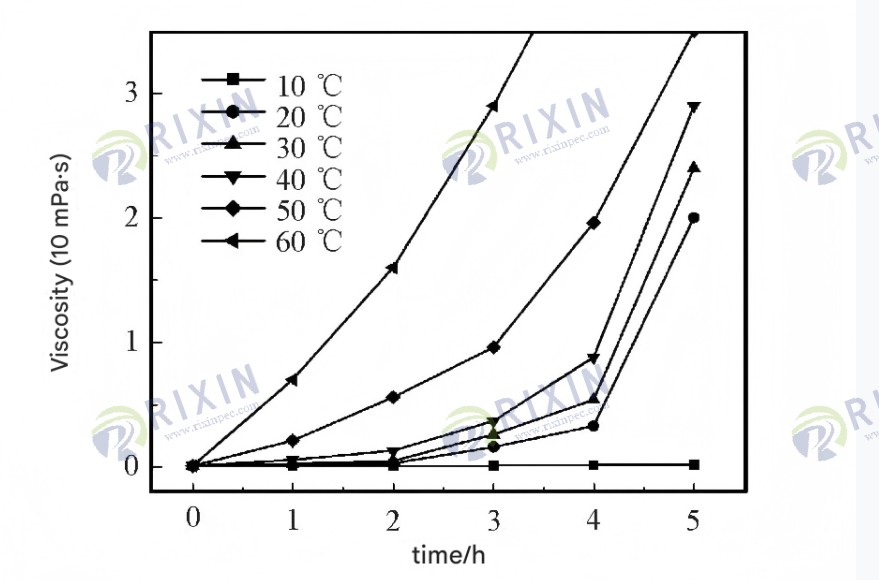
Figure 1 shows the viscosity variation of the high-strength liquid plugging system with test time at different temperatures. At 10℃, the viscosity of the plugging agent changes slowly with increasing test time, increasing only from 90 mPa·s to 200 mPa·s within 5 hours. Between 20 and 40℃, the viscosity of the plugging agent increases continuously within 4 hours and increases significantly after 5 hours, indicating that the plugging agent has essentially solidified. Between 50 and 60℃, the viscosity of the plugging agent increases rapidly, quickly forming and solidifying. The experimental results confirm that the plugging agent can be used in the temperature range of 20–50℃, providing sufficient injection time on the ground to inject the plugging agent into the annulus for sealing, reducing equipment damage and construction risks.
Figure 1. Viscosity of high-strength liquid sealant over time at different temperatures.
2.2.2 Infrared Spectroscopic Analysis
The curing mechanism of the plugging agent was investigated by infrared spectroscopy. The infrared spectra of the main agent and the products of the plugging agent curing reaction with a mass ratio of main agent to curing agent of 4:1 and 3:1 are shown in Figure 2. In the spectrum of the main agent, the characteristic peak of the epoxy group at 946 cm-1 appears, the stretching vibration peaks of -CH3 and -CH2- appear at 2872 cm-1, and the C=C stretching vibration peaks of the benzene ring appear at 1564 cm-1 and 1608 cm-1 [15]. In the spectrum of the products of the plugging agent curing reaction, the characteristic peak of the epoxy group at 946 cm-1 disappears, and a broad hydroxyl characteristic peak appears at 3586 cm-1. This is because during the crosslinking process, the amine group in the curing agent can cause the epoxy group to undergo a ring-opening reaction and generate hydroxyl groups. The different ratios of the main agent and the curing agent have little effect on the reaction. The molecular structure of the product is basically the same, forming a stable three-dimensional network structure. The curing process of the plugging agent is a significant ring-opening exothermic reaction, and after curing, a stable structure is formed that is not affected by temperature or acidity/alkalinity.
Figure 2. Infrared spectrum of high-strength liquid sealant.
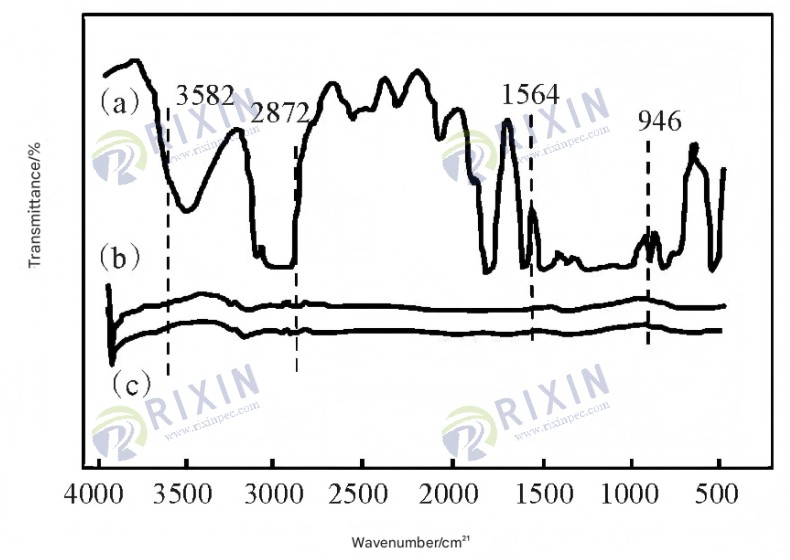
(a) Main agent; (b) Main agent to curing agent mass ratio = 4:1; (c) Main agent to curing agent mass ratio = 3:1.
2.2.3 Mechanical properties of plugging agent
The compressive strength of the cured high-strength liquid sealant was tested using a universal press. In the experiment, the sample was first placed vertically on the universal press, and the pressure was gradually increased while observing the deformation of the sealant column. When the pressure reached 5.1 MPa (standard deviation S=0.204), the sample underwent significant deformation. After gradually reducing the pressure, the sample returned to its original shape and size, showing no signs of breakage or deformation due to pressure. When the sealant column was compressed again, the pressure at which significant deformation occurred during multiple compression tests remained above 5.0 MPa, demonstrating excellent compressive strength.
2.2.4 SEM Analysis
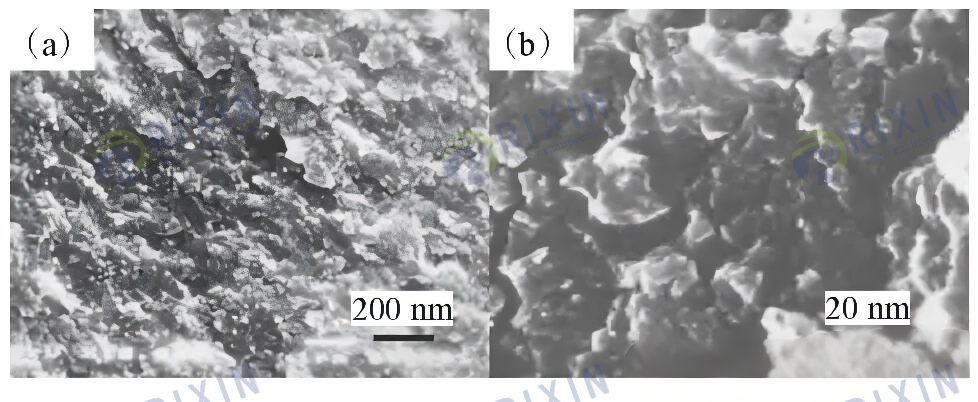
The cured high-strength liquid sealant was observed using SEM to evaluate its microstructure, as shown in Figure 3. The cured liquid sealant exhibits a uniform, dense structure with embedded microparticles within this overall dense matrix. This is likely due to the use of γ-methacryloyloxypropyltrimethoxysilane. The silane molecules cluster and act as buffer groups within the resin’s cross-linked structure, enhancing the sealant’s toughness and resulting in better pipe wall adhesion and pressure resistance.
Figure 3. SEM image of the cured liquid high-strength sealant.
2.3 Sealing performance of high-strength liquid plugging agent
2.3.1 Casing Simulation
The sealing capability of the plugging agent after curing was tested using a simulated casing (φ2.5 cm × 25 cm). Considering the possibility of brine or other liquids in the wellbore, the simulated casing was placed vertically and pre-filled with brine. Then, a high-strength liquid plugging agent was injected to fill two-thirds of the casing, displacing the brine and sealing the top. After two days of curing, the casing cap was opened and the top brine was poured out, indicating complete curing of the plugging agent and the formation of a solid sealing layer. The casing cap was tightened, and a pumping device and pressure testing device were connected. Water was pumped in to observe the pressure resistance. The results showed that the plugging agent achieved a high compressive strength of >160 MPa/m in the simulated casing, exhibiting good adhesion, and no water seeped from the other side of the casing. This indicates that the plugging agent has excellent pressure-bearing sealing capability.
2.3.2 Settlement Simulation
The settling and sealing performance of a high-strength liquid plugging agent was investigated using a hose settling test. A 20 m long hose (φ2.5 cm) was vertically installed and filled with brine. The prepared plugging agent was injected from the top, and as the plugging agent was injected, the brine was continuously displaced from the top. The plugging agent continuously settled in the brine and accumulated at the bottom of the 20 m hose. During the settling process, the plugging agent did not mix with the water; it clumped together and settled in the hose at a relatively fast settling rate. After all the injected plugging agent had settled to the bottom, the hose was left to solidify. After 3 days, the plugging agent had completely filled the inner wall of the hose and solidified into a plugging agent column, while there was no plugging agent residue in the upper hose space, which remained filled with brine. The experimental results show that the plugging agent still has good sealing performance at a relatively high height, is not disturbed by the settling medium, and leaves no agent residue during the settling process, demonstrating strong sealing ability.
2.4 Field Application Status
A production well in Oilfield A in the eastern South China Sea is a horizontal well with a mudline at 151.1 m. Above the mudline, the casing (the casing reconnected above the mudline) consists of 9-5/8”, 13-3/8”, and 20” casings, respectively. The 13-3/8” casing in this well exhibits a certain degree of corrosion, which will worsen if not treated promptly. Electromagnetic noise testing revealed a leak in the B/C annulus (13-3/8” casing) of the well, located at 139.4 m (mud surface 151.1 m). Using an automated tubing insertion process without moving the tubing string, 5 m³ of a settling, high-strength liquid plugging agent was injected into the C annulus and allowed to settle autonomously to the leak location. This resulted in the plugging agent forming a complete liquid ring enveloping the annulus. Utilizing the plugging agent’s permeability and ability to penetrate micro-voids, the annulus was sealed with sufficient strength, achieving complete plugging. During the operation, the excellent performance of the plugging agent system ensured safe preparation under high-temperature conditions on-site and complete solidification under low-temperature conditions downhole. After 48 hours of curing, a pressure test was conducted on the B annulus, reaching 1.379 MPa and stabilizing for 10 minutes, confirming the successful completion of the plugging operation.
3. Conclusion
The liquid high-strength sealing agent prepared through the optimization of the main agent and curing agent system has good settling and curing performance as well as excellent pressure bearing capacity (>160 MPa/m), and has been successfully applied in the field in the eastern part of the South China Sea.
This plugging agent can cope with the complex conditions and needs of wellbore integrity management in offshore oil fields and meet the plugging requirements under various operating conditions.
Optimizing the types and ratios of the main agent and curing agent, and rationally controlling the speed of the cross-linking and curing process, are key to achieving both pipe wall adhesion and pressure resistance. This study provides a novel high-strength plugging system for offshore wellbore integrity management, and the product has promising application prospects.
