Address
304 North Cardinal St.
Dorchester Center, MA 02124
Work Hours
Monday to Friday: 7AM - 7PM
Weekend: 10AM - 5PM
Address
304 North Cardinal St.
Dorchester Center, MA 02124
Work Hours
Monday to Friday: 7AM - 7PM
Weekend: 10AM - 5PM

In the oil industry, the method of oil recovery which only relies on various natural energies such as rock expansion, edge water drive, gravity and natural gas expansion is usually called primary oil recovery. The oil production method of increasing reservoir pressure by gas injection or water injection is called secondary oil production. By injecting fluid or heat to change the viscosity of crude oil or change the interfacial tension between crude oil and other media in the formation, the method of displacing discontinuous and difficult to recover crude oil in the reservoir is called

tertiary oil recovery.
In the primary oil recovery phase, oil that has been lying in the ground for eons of time can rely on natural energy to escape the obstacles that cover them and flow through the well to the surface. This energy comes from the heavy pressure exerted by the rocks on top of them on the strata and the fluids within them. Under the weight of the overlying strata, a large amount of elastic energy accumulates in the rocks and fluids. When the oil layer is connected to the surface through the well, there is low pressure at the wellhead and high pressure at the bottom of the well. With this pressure difference, the overlying layer acts like a sponge to push oil from the reservoir into the well and lift it to the surface. With the continuous production of crude oil and natural gas, the volume of fluid in the reservoir rock and formation gradually expands, and the elastic energy is gradually released. One day, when the elastic energy is not enough to lift the fluid up, the new pressure balance in the formation is slowly established, and the fluid no longer flows, and a large amount of oil will be trapped underground. Just like when a spring is compressed, it starts out very elastic, and as the volume of the spring expands, the elasticity becomes weaker and weaker, and eventually it loses its elasticity.
In the secondary oil production stage, people increase the pressure of the oil reservoir by injecting gas or water into the oil reservoir to supplement elastic energy for the rocks and fluids in the formation, so that the new pressure balance between the rocks and fluids in the formation can not be established, and the formation fluids can always flow to the oil well, so that the oil can be produced only by natural energy. However, due to the heterogeneity of the formation, the injected fluid always flows along the path of least resistance to the well, and the oil in the area of relatively high resistance will not be displaced. Even in areas that have been flooded with fluid, there is still a certain amount of oil that cannot be recovered due to the adsorption of oil by rocks, just as washing with water does not remove oil stains from clothing. In addition, some crude oil in the ground like asphalt, can not flow in the formation of the porous medium, so the ability of secondary oil recovery methods to improve oil recovery is limited.
In the tertiary oil recovery stage, people can increase the flow capacity of crude oil and further
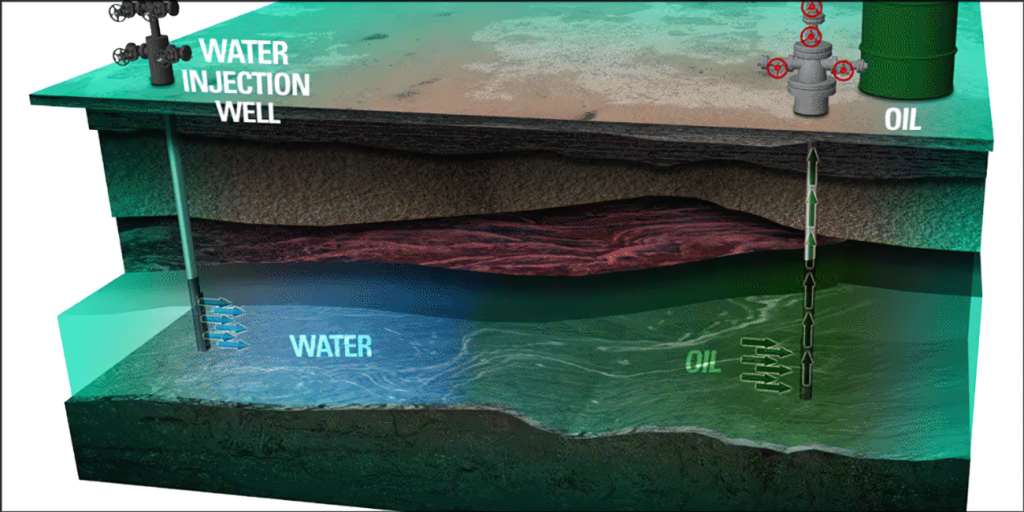
In the tertiary oil recovery stage, people can increase the flow capacity of crude oil and further improve the oil recovery by changing the viscosity of crude oil and the adsorbability of rock by various physical and chemical methods. The main methods of tertiary oil recovery include thermal oil recovery, chemical oil displacement, miscible oil displacement, microbial oil displacement and so on.
Chemical flooding method is mainly to increase the viscosity of formation water by injecting some chemical agents, change the viscosity ratio of crude oil and formation water, reduce the gap between the flow capacity of water in the formation and the flow capacity of oil, at the same time, reduce the adsorption of crude oil to the rock, so as to expand the area of viscous water flooding and improve the efficiency of oil flooding. In Daqing oilfield, polyacrylamide injection polymer has been used as the main body in three oil recovery tests, which has significantly increased the oil recovery rate and achieved considerable economic benefits. Miscible flooding method is mainly through the injection of gas and crude oil miscible, can reduce the viscosity of crude oil and rock adsorption, commonly used gases are natural gas and carbon dioxide. Microbial oil flooding is the use of microorganisms and their metabolites can crack heavy hydrocarbons and paraffin, so that the large molecules of petroleum into small molecules, while the metabolized gases such as CO2, N2, H2, CH4 can be dissolved in crude oil, thus reducing the viscosity of crude oil, increasing the flow of crude oil, to achieve the purpose of improving oil recovery.
