Address
304 North Cardinal St.
Dorchester Center, MA 02124
Work Hours
Monday to Friday: 7AM - 7PM
Weekend: 10AM - 5PM
Address
304 North Cardinal St.
Dorchester Center, MA 02124
Work Hours
Monday to Friday: 7AM - 7PM
Weekend: 10AM - 5PM


Rhamnoolipids are anionic biosurfactants produced by microorganisms. They not only dissolve in methanol, chloroform and ether, but also show good solubility in alkaline aqueous solution. It has good chemical and biological properties. It is amphiphilic to oil and water, can reduce the surface tension of water, can be used as a wetting agent, emulsifier and foaming agent, rhamnose-lipid biosurfactant can be used under extreme conditions of temperature, PH and salinity, and is non-toxic and biodegradable.
At present, it is widely used in the petroleum industry, green agriculture and ecological environment, in addition to the food industry, cosmetics, medical treatment also has greater application potential.
Rhamnoolipid, as a biosurfactant, has the effect of reducing the interfacial tension of oil and water. It is used in the third recovery technology after
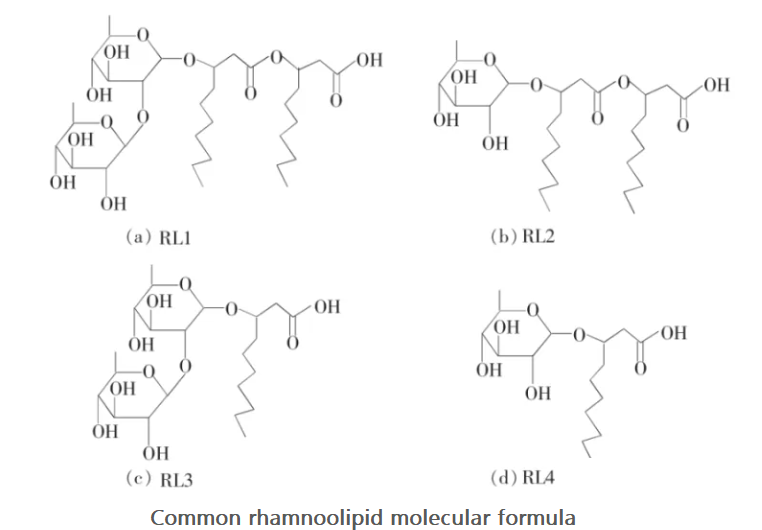
primary oil recovery and secondary oil recovery. The main principles are as follows:
(1) As a sacrifice agent, it can reduce the amount of expensive oil displacement agent or the loss in the formation. After combining with other oil displacement agents, it has the advantages of good oil displacement effect and long response time, but the addition of rhamnose-lipids effectively reduces the amount of oil displacement agent and greatly reduces the cost.
(2) Biosurfactants have typical biological activities, which can activate the original microorganisms of the formation and play a synergistic role in oil recovery. It is found in the field test water sample of the oilfield that the bacterial content in the water sample of the oil well after six months of injection is increased by 2-3 orders of magnitude compared with that before injection.
(3) As an active agent, rhamnose-olipid itself is a surfactant, which can reduce the oil-water interfacial tension, and the oil-water interfacial tension can reach the level of 10-3mN/m after the combination of oil displacement agent, thus improving the efficiency of crude oil displacement.
As an environmentally friendly chemical additive, rhamnoolipid has high thermal stability and oxidation stability, which can be stable and effective in high temperature and high pressure oilfield environment. It can improve the separation effect of oil and water and improve the efficiency of oil production, and has been widely concerned.
Excellent examples of international application:
1. In an oil field in Uzbekistan, rhamnoolipid is used as a lubricant for underground storage tanks and pipelines. By using rhamnose-grease, the adhesion and blockage of fluid in storage tanks and pipelines can be reduced, and the flow and collection efficiency of oil can be improved.
2. In the Siberian region of Russia, an oil company used rhamnose-lipids in the viscous displacement process of oil Wells. The lubricant is compatible with the oil-water mixture in underground reservoirs to form a stable emulsification system and improve oil flow and recovery.
3. In an undersea oil field near Vancouver Island in Canada, a multinational oil company used rhamnoolipid as a cement strength modifier to improve cement cementing quality. This lubricant improves the fluidity and viscosity of the cement slurry, increasing the strength and durability of the cementing bond.
4. In Alberta, Canada, a major oil and gas exploration company replaced traditional petroleum-based lubricants with rhamnose-lipids, successfully mitigating the environmental impact of lubricants and significantly reducing the risk of environmental contamination.
5. Rhamnose-lipid-based lubricants are used to lubricate drilling hoses in a shale gas field in Texas. Compared to traditional mineral oil-based lubricants, rhamnose-grease reduces the risk of friction, wear and internal hose corrosion, thereby improving the efficiency and safety of drilling operations.
These cases show that rhamnoolipid has great potential in the oilfield industry. Its excellent thermal stability and lubrication performance can improve reservoir development efficiency, reduce production costs, and reduce the risk of environmental pollution. The application prospect of rhamnose-lipids is expanding continuously, and it has become one of the indispensable petroleum additives in the international oilfield industry.

Touche. Solid arguments. Keep up the good effort. https://www.waste-ndc.pro/community/profile/tressa79906983/
TKS
Nice blog here! Also your web site quite a bit up fast!
What host are you the usage of? Can I get your associate hyperlink to your host?
I desire my web site loaded up as fast as yours lol https://menbehealth.wordpress.com/
Your website is not bad either
Your website is not bad either!